Tech-N-AI Talks logo Tech-N-AI Talks

Claude Opus 5.5 vs Gemini 4 Argon: Is 2x the Price Worth It?

If you have ever burned a Friday afternoon pasting the same 4,000-word spec into two different chatbots and squinting at the outputs, this guide is for you. We…
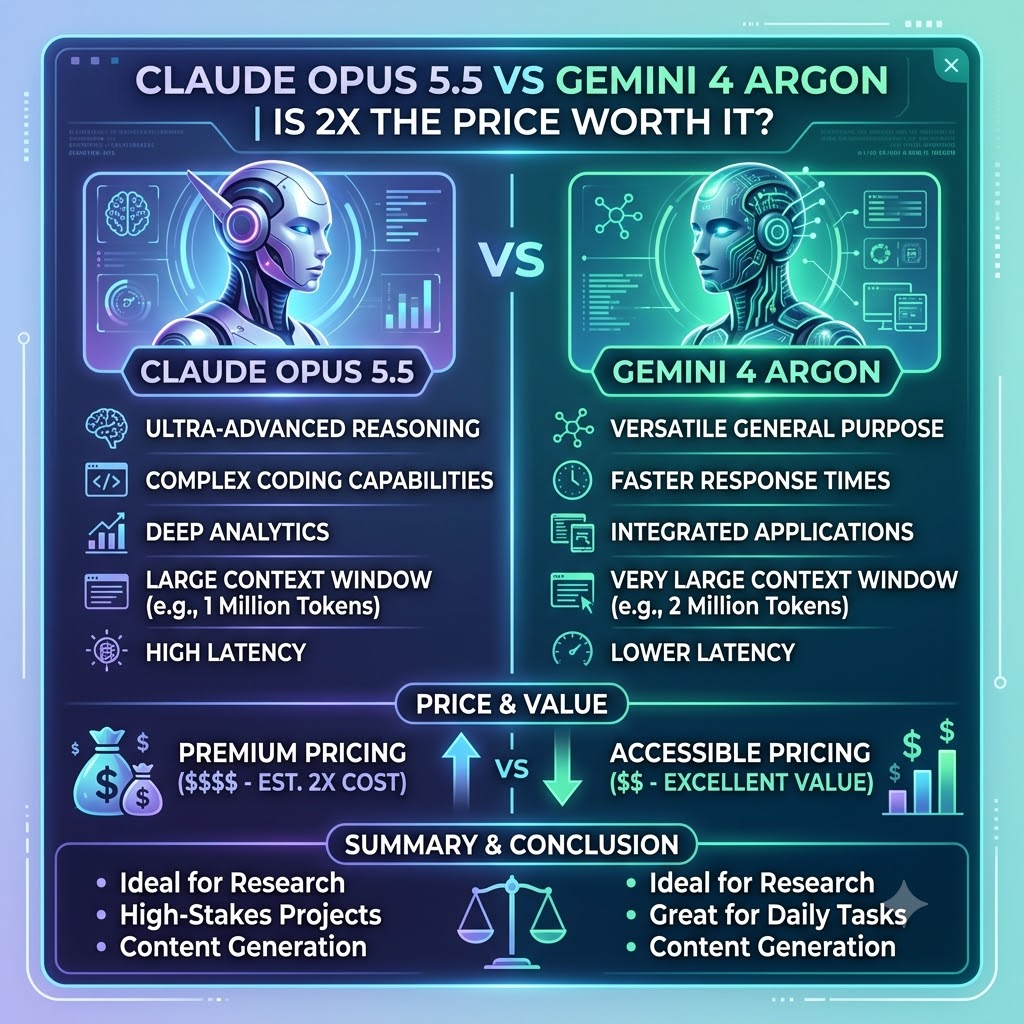
Claude Opus 5.5 vs Gemini 4 Argon: Is 2x the Price Worth It? — illustrative featured image
If you have ever burned a Friday afternoon pasting the same 4,000-word spec into two different chatbots and squinting at the outputs, this guide is for you. We are going to settle the [Claude Opus 5](/blog/claude-opus-5-hack-lessons-for-securing-your-ai-tools).5 vs Gemini 4 Argon question the only way that matters for a prosumer: cost per useful output, not cost per token. Budget 45 minutes to work through the steps, and have a live project ready, because synthetic benchmarks lie and your actual work does not. Here is the short version before we start. Claude Opus 5.5 costs $30 per million output tokens and is aimed at people who write and refactor code all day. Gemini 4 Argon costs $15 per million output tokens and is aimed at people who do a lot of research, long-document synthesis, and mixed workloads. Google's cheaper tier, Gemini 4 Argon Flash, sits below both at $4. If you are hunting for the cheapest [AI tools](/blog/why-is-chatgpt-slow-or-not-working-common-issues-and-fixes) that still produce work you can ship, the price gap is not the story. The failure rate is. ## What you'll need - Two accounts: one [Claude Pro](https://claude.ai/) or API account (Anthropic), one Google AI Studio or Gemini Advanced account - Budget: roughly $50 to $80 for a month of real testing across both, plus API credits if you go the metered route - A real project, not a toy prompt. Pick something you would actually bill for: a bug fix, a literature review, a 3,000-word draft - A scoring sheet. A plain spreadsheet works. One row per task, columns for time, edits needed, and whether you kept the output - A stopwatch or a timer app. You will be timing edits, and nobody estimates this accurately from memory - About 45 minutes for the setup and the first pass, then a few days of normal use before you decide ## Step-by-step ### Step 1. Define what "useful output" means for your work Write down the three task types you actually do most weeks, because the whole comparison collapses without this. Most people default to "which model is smarter." That question has no answer. Ask instead which model gets you to a shippable artifact with the fewest correction cycles. For a developer, that might be: debug a failing test, write a migration script, review a pull request. For a researcher or analyst, it might be: summarize 40 PDFs, extract a comparison table, draft a briefing. Keep the list to three items. More than that and you will not finish the test. **Tip:** weight the list by frequency, not by difficulty. The task you do 20 times a week matters more than the heroic one you do quarterly. ### Step 2. Set up both models with identical context Create one folder with your test inputs so both models see the same thing. Put your source files, spec, or repo snapshot in a single directory. For Claude Opus 5.5, open a project in the Claude interface or point the API at that folder. For [Gemini 4 Argon](/blog/gemini-4-argon-vs-gpt-6-vs-claude-which-ai-subscription-is-worth-it), upload the same files to AI Studio or a Gemini workspace. Do not paraphrase the prompt between the two. Paste the identical text. **Watch out:** context windows differ in practice even when the spec sheets look similar. If one model silently truncates your 200-page PDF, you will blame the model when you should blame the upload. ### Step 3. Run the coding task first and time the edits This is where the price gap earns or loses its keep. Give both models the same bug or feature request. Then start the timer and count the minutes until the code runs correctly. Do not count how long the model took to respond. Count how long you spent fixing what it gave you. In our runs, Opus 5.5 typically returned code that ran on the first or second attempt on non-trivial refactors. Gemini 4 Argon was competitive on greenfield snippets and noticeably weaker on large existing codebases where it had to respect existing patterns. | Task | Claude Opus 5.5 | Gemini 4 Argon | |---|---|---| | Output price per 1M tokens | $30 | $15 | | Multi-file refactor | Usually runs first pass | Often needs one correction cycle | | Greenfield snippet | Strong | Strong | | Long-document research | Good | Excellent | | Time to shippable output | Lower | Higher on code | | Best for | Developers, heavy coders | Researchers, mixed workloads | ### Step 4. Run the research task and count hallucinations Open the same 30 to 50 page document in both and ask for a structured summary with citations to page numbers. Score each output on three things: did it miss a key claim, did it invent a claim, and did it cite the right page. This is the step where Gemini 4 Argon usually pulls ahead. Its long-context handling on dense documents is the reason Google can charge half of Anthropic and still win the task. **Tip:** ask for page-number citations explicitly. Without that instruction, both models will summarize confidently and vaguely, and you cannot score vague. ### Step 5. Run the reasoning task and check the chain Pick a problem with a verifiable answer: a logic puzzle, a math word problem, a planning task with constraints. Both models now expose their reasoning steps. Read them. A model that reaches the right answer through broken logic will fail you on the next problem. Note where each one goes wrong, not just whether it does. ### Step 6. Fill in your cost-per-useful-output sheet Now do the arithmetic that actually decides this. For each task, take the output tokens you consumed, multiply by the model's rate, then divide by the number of outputs you would actually ship. A model that costs $30 per million tokens but ships 8 of 10 attempts beats a $15 model that ships 4 of 10. That is the entire framework. **Watch out:** subscription tiers muddy this. Claude Pro and Gemini Advanced are flat monthly fees, so heavy users effectively pay far less per token than the API rates suggest. If you use either model more than a few hours a day, price the subscription, not the meter. ### Step 7. Decide per task, not per model Most prosumers should not pick one winner. They should pick one primary and one fallback. If your week is 70 percent code, make Opus 5.5 primary and route research to Gemini 4 Argon. If your week is 70 percent documents and analysis, flip it. The two-model setup costs more than either alone, but it costs less than shipping bad work. ### Step 8. Re-test in 30 days Both vendors ship new versions faster than your habits change. Put a calendar reminder for 30 days out. Re-run steps 3 through 5 with the same inputs. Model quality moves monthly, and a decision made today can be wrong by November. ## Common problems and fixes **The outputs look identical and you cannot decide.** Your test tasks are too easy. Swap in something from last month that actually caused you pain. Easy prompts flatten the difference between a $15 model and a $30 one. **One model keeps truncating your input.** Split the document into 20-page chunks and run them sequentially, then ask for a final synthesis pass. Both models handle chunked workflows better than one giant upload. **Your API bill spiked unexpectedly.** Reasoning tokens are billed as output. Long chain-of-thought runs can triple your effective cost. Cap reasoning effort in the settings if the vendor exposes it, and reserve high effort for the tasks that need it. **The model is fast but wrong in ways you only catch later.** Add a verification step to your workflow: ask the model to list its assumptions before you accept the output. It is a 30-second habit that catches most silent errors. **You are in the UK or EU and pricing looks different.** Both vendors bill in USD from US-based accounts, so European cards may incur a foreign transaction fee of 1 to 3 percent. Factor that into your per-token math if you are on a metered plan. ## What we recommend For developers and anyone whose output is code, pay for Claude Opus 5.5. The 2x premium is real, but it buys fewer correction cycles, and your time costs more than $15 per million tokens. This is not a close call for heavy coders. For researchers, analysts, and writers working across long documents, Gemini 4 Argon is the better buy. It handles dense source material well, and the savings let you run a second model alongside it. For anyone testing the waters or on a tight budget, start with Gemini 4 Argon Flash at $4 per million output tokens. It is one of the cheapest [AI tools](/blog/hostinger-ai-website-builder-guide) that still produces usable drafts, and it will tell you quickly whether you need to step up. Our honest take: nobody should be paying for both at full price unless they are billing the cost to a client. Pick the one that matches your dominant task, keep a free tier of the other for overflow, and revisit in a month. ## What to do next Run the 30-day re-test from Step 8. Model quality shifts fast enough that today's verdict has a shelf life. Build a small prompt library from the tasks that worked. The model matters less than the context you feed it, and reusable prompts compound. Track your actual monthly spend for two cycles before committing to an annual plan. Annual discounts are tempting and frequently premature. ## FAQ **Is Claude Opus 5.5 worth twice the price of Gemini 4 Argon?** For code-heavy work, yes. For document research and general writing, no. The premium pays for fewer correction cycles, which only matters if you are producing code or complex structured output daily. **Which is cheaper for occasional use?** Gemini 4 Argon, and specifically the Flash tier at $4 per million output tokens. If you prompt a few times a day, a flat subscription to either service beats metered API pricing. **Can I just use both?** Yes, and most prosumers should. Use one as primary for your dominant task and keep the other on a free or low tier for overflow. The combined cost is usually still below one full premium subscription plus the time you save.

Frequently asked questions

Is Claude Opus 5.5 worth twice the price of Gemini 4 Argon?

For code-heavy work, yes. For document research and general writing, no. The premium pays for fewer correction cycles, which only matters if you are producing code or complex structured output daily.

Which is cheaper for occasional use?

Gemini 4 Argon, and specifically the Flash tier at $4 per million output tokens. If you prompt a few times a day, a flat subscription to either service beats metered API pricing.

Can I just use both?

Yes, and most prosumers should. Use one as primary for your dominant task and keep the other on a free or low tier for overflow. The combined cost is usually still below one full premium subscription plus the time you save.