
Tech-N-AI Talks logo Tech-N-AI Talks

AI vs Human Reasoning: Goldman Sachs Warns on Bankers' Judgm

Discover why Goldman Sachs cautions against replacing bankers' judgment with AI. Learn the risks and how to balance automation with human insight. Read more.
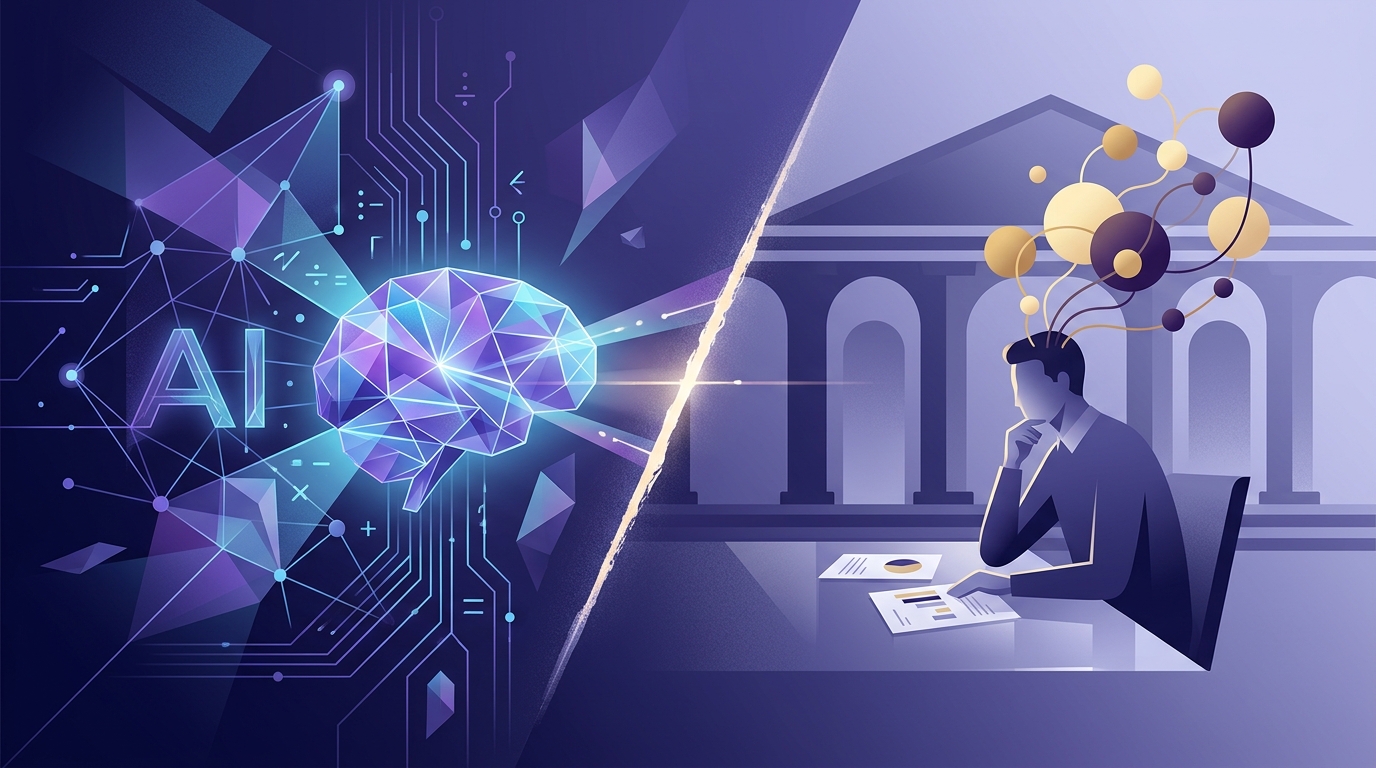
AI vs. Human Reasoning: Why Goldman Sachs Warns Against Replacing Bankers' Judgment, illustrative featured image
The 2008 financial crisis was, at its core, a failure of imagination. Models priced risk, but no one priced in the possibility that everyone would run for the exit at the same time. Fast forward to 2024, and we are watching the industry flirt with a similar blind spot, albeit one powered by silicon rather than spreadsheets. When a senior Goldman Sachs partner publicly warns that letting AI replace a banker's reasoning skills poses a "huge danger," it is not the Luddite whimper of a legacy executive. It is a signal that the people building the machines are terrified of the people deploying them. The tension isn't about whether AI can crunch numbers faster. It can. The question is whether a stochastic parrot can replicate the messy, context-laden judgment required to price a complex derivative or negotiate a cross-border merger. For tech enthusiasts eager to automate everything, this is the friction point. For the finance sector, it is a survival issue. ## The verdict at a glance This isn't a battle between two software products; it is a battle between two cognitive approaches. **AI wins on speed, scale, and pattern recognition.** **Human reasoning wins on accountability, adaptability, and handling the "unknown unknowns."** For high-stakes financial decisions where a wrong call costs millions, the clear winner is **Human-in-the-loop reasoning**, where AI acts as a tireless analyst but a human retains veto power. If you are a fintech startup looking to automate back-office reconciliation, go full AI. If you are a wealth manager making allocation calls for a pension fund, you are legally and ethically insane to remove the human. ## Quick comparison table | Feature | AI Reasoning (LLM/ML) | Human Judgment (Bankers) | | :--- | :--- | :--- | | **Data Processing Speed** | Processes millions of datapoints in seconds | Reads a few hundred pages of filings in a day | | **Pattern Recognition** | Excellent at detecting historical correlations | Struggles with volume, but excels at spotting anomalies | | **Contextual Nuance** | Often misses sarcasm, political subtext, or cultural cues | Inherently understands office politics and client sentiment | | **Explainability** | Black box; hard to audit "why" a decision was made | Can articulate reasoning in a boardroom (even if flawed) | | **Adaptability** | Catastrophic failure when market structure shifts | Humans adapt to regime changes, albeit slowly | | **Hallucination Risk** | High; will confidently invent facts or precedents | Low; but prone to cognitive biases (overconfidence) | | **Regulatory Liability** | The firm is liable for the AI's output | The individual is liable for their signature | | **Cost of Training** | High initial cost, low marginal cost per query | High salary, high retention risk, high burnout | | **Best Use Case** | Drafting research summaries, flagging anomalies | Final sign-off on trades, client relationships, crisis management | ## AI Reasoning, where it shines ### The tireless analyst Let's be honest about what AI is actually good at in finance: the grunt work. Goldman's internal models can scrape earnings call transcripts, regulatory filings, and news feeds to generate a preliminary credit memo in minutes. A junior analyst takes a week. A study by McKinsey suggested that generative AI could automate up to 70% of the data collection and initial drafting tasks in corporate banking. That is not a threat to judgment; that is a threat to busywork. If your firm is still paying humans to copy-paste data from one spreadsheet to another, you are leaving money on the table. ### Pattern matching at scale In algorithmic trading and risk management, AI is unmatched. It can detect subtle correlations between asset classes that a human would never notice. For example, AI models can monitor satellite images of retail parking lots to predict quarterly earnings before the company announces them. This is not "reasoning" in the philosophical sense, but it is a massive competitive advantage. For quant funds, the AI is the product. The human is just there to fix the code when the market breaks. ### The speed of compliance Regulatory reporting is a nightmare of structured data and strict deadlines. AI excels here because the rules are (mostly) deterministic. It can generate suspicious activity reports (SARs) and transaction monitoring alerts with a speed that manual teams cannot match. This is the safe zone for automation. If the task is "find anomalies in this dataset," let the machine do it. If the task is "decide if this anomaly is a crime," call a human. ## Human Reasoning, where it shines ### The judgment call on "no data" The Goldman Sachs warning centers on a specific failure mode: when the AI has no historical precedent to draw from. Consider the COVID-19 crash in March 2020. Every model that relied on historical volatility failed because there was no historical precedent for a global economic shutdown. A human trader, relying on gut instinct and an understanding of human fear, could at least make a qualitative guess. An AI, lacking that data, will confidently price options based on a world that no longer exists. That is the "huge danger" the partner referenced. This risk is not hypothetical, as [Nvidia's AI banker role](/tech/blog/nvidia-s-ai-banker-role-smart-strategy-or-risky-gamble) shows even tech giants are wrestling with the same uncertainty. ### The art of the relationship Banking is a relationship business. It always has been, and it always will be. An AI cannot take a client to dinner and read their body language to gauge whether they are bluffing about a competing offer. It cannot sense the hesitation in a CFO's voice when discussing a leveraged buyout. These subtle social signals are the bedrock of negotiation. Removing human judgment here strips the "relationship" out of relationship banking, reducing it to a commodity transaction where the only differentiator is price. ### Accountability and the "Why" When a trade goes bad, the SEC doesn't subpoena the algorithm. They subpoena the human. A banker's value lies in their ability to stand in front of a risk committee and say, "I priced this at X because I believe the regulatory environment is shifting." The AI can tell you the probability of default is Y, but it cannot defend that number against a skeptical regulator. It cannot be cross-examined. In high-stakes finance, the ability to be wrong with a defensible rationale is more valuable than being right with a black box. ## Pricing & value We are not comparing subscription tiers here, but the cost of these cognitive assets. - **AI Tools (LLM APIs, internal models):** Costs range from $0.01 per 1k tokens for cheap models to $60 per 1k tokens for premium reasoning models. A firm deploying a custom fine-tuned model can expect to spend between $500,000 and $2 million annually on compute, data storage, and ML engineers. The marginal cost of a "decision" is near zero. - **Human Bankers (Junior to MD):** A junior analyst in New York costs roughly $150,000 to $250,000 in total compensation. A Managing Director costs between $1 million and $5 million. The marginal cost per decision is high, but the value of a single correct M&A call can be worth billions. The math is seductive. Replacing three analysts with one AI subscription saves $400,000 a year. But if that AI hallucinates a clause in a legal contract and costs the firm a $50 million lawsuit, the math flips. The value proposition is not "AI vs Human" pricing; it is "AI augmentation cost" (the price of the API) versus "Human error cost" (the price of the lawsuit). ## Which one should you choose - **If you are a quantitative hedge fund** running high-frequency strategies, choose the AI. Your edge is speed and statistical arbitrage. Human reaction time is a liability. Use humans only to rewrite the code when the market regime shifts. For more on how hedge funds stack up against other vehicles, see our [insights from Goldman's latest report](/finance/blog/how-to-choose-between-hedge-funds-and-mutual-funds-insights-from-goldman-s-lates). - **If you are a commercial banker or M&A advisor**, choose the Human, augmented by AI. Use the AI to do the due diligence heavy lifting and generate the initial drafts. But the final valuation, the negotiation strategy, and the client relationship must be human. Your clients are paying for your judgment, not your ability to run a Python script. - **If you are a fintech startup** building a robo-advisor for retail investors, choose a hybrid. Use AI for portfolio rebalancing and tax-loss harvesting. But ensure that any account over $100,000 gets a human review, because the regulatory risk and client churn from a bad automated call will kill you. Retail investors weighing similar decisions may want to check whether [foreign funds leaving India](/finance/blog/foreign-funds-are-leaving-india-should-retail-investors-worry) is a cause for concern. ## Our take: The augmentation ceiling Here is the uncomfortable truth that the Goldman Sachs partner is pointing at. The danger is not that AI is too smart. The danger is that we are getting lazy. We are so enamored with the speed of the output that we stop checking the logic. The "reasoning" skills of a banker are like a muscle. If you use AI to skip the workout, the muscle atrophies. We recommend a strict policy: **AI must propose, but the human must dispose.** We are not Luddites. We use AI tools daily to draft outlines and summarize research. But we never publish a benchmark result without manually verifying the data source. In finance, the stakes are higher. Firms like Goldman should invest heavily in AI for data processing, but they should also invest in training their bankers to be skeptical of the AI's output. The real competitive advantage in 2025 will not be who has the best model. It will be who has the best humans to question it. As [AI agents rise](/tech/blog/the-rise-of-ai-agents-will-they-replace-your-saas-stack), the ability to manage these tools critically becomes even more essential. ## FAQ ### Can AI completely replace human reasoning in finance? No. AI can replace the *execution* of reasoning (data processing, pattern recognition) but not the *justification* of it. In regulated industries, you need a human to take responsibility for the decision. AI cannot be deposed, it cannot be fired, and it cannot be held criminally liable for fraud. ### What is the upgrade path from a human-only workflow to an AI-augmented one? Start with low-risk, high-volume tasks like data extraction and drafting. Deploy AI there and measure the error rate. Once you trust the AI on those tasks, move to mid-level risk like portfolio risk scoring. Do not jump straight to autonomous trading or client-facing advice. The upgrade path is a pyramid: automate the base, but keep the apex human. ### What is the deal-breaker for using AI in high-stakes decisions? The deal-breaker is the **hallucination rate**. If your AI model confidently states that a company has no debt when it has $2 billion in debt, and a human doesn't catch it, the deal collapses. If the model cannot provide a source for every single factual claim it makes, it is not ready for client-facing use. Always run a "red team" test where you feed the AI adversarial data to see if it breaks. For a broader look at adapting to AI-driven changes, our guide on [SEO in the age of AI](/dgtg/blog/seo-in-the-age-of-ai-how-to-adapt-your-strategy-for-2026) offers useful parallels.

Frequently asked questions

The tireless analyst Let's be honest about what AI is actually good at in finance: the grunt work. Goldman's internal models can scrape earnings call transcripts, regulatory filings, and news feeds to

No. AI can replace the *execution* of reasoning (data processing, pattern recognition) but not the *justification* of it. In regulated industries, you need a human to take responsibility for the decision. AI cannot be deposed, it cannot be fired, and it cannot be held criminally liable for fraud.

What is the upgrade path from a human-only workflow to an AI-augmented one?

Start with low-risk, high-volume tasks like data extraction and drafting. Deploy AI there and measure the error rate. Once you trust the AI on those tasks, move to mid-level risk like portfolio risk scoring. Do not jump straight to autonomous trading or client-facing advice. The upgrade path is a pyramid: automate the base, but keep the apex human.

What is the deal-breaker for using AI in high-stakes decisions?

The deal-breaker is the **hallucination rate**. If your AI model confidently states that a company has no debt when it has $2 billion in debt, and a human doesn't catch it, the deal collapses. If the model cannot provide a source for every single factual claim it makes, it is not ready for client-facing use. Always run a "red team" test where you feed the AI adversarial data to see if it breaks. For a broader look at adapting to AI-driven changes, our guide on [SEO in the age of AI](/dgtg/blog/s